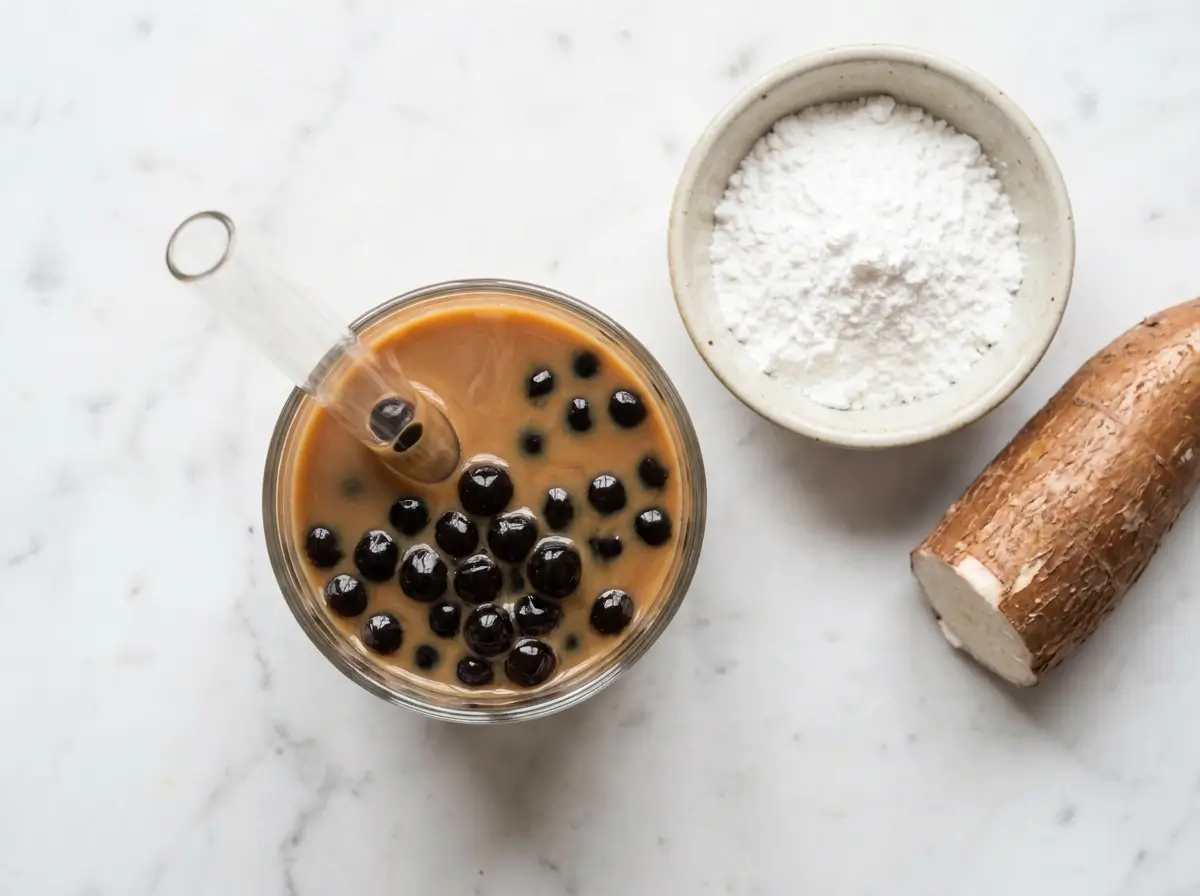
Does boba have gelatin? No — traditional tapioca pearls (boba) do not contain gelatin. This surprises many people because the chewy, bouncy texture of boba feels similar to gelatin-based gummies. But boba gets its texture from tapioca starch — a completely plant-based ingredient extracted from the cassava root — not from animal-derived gelatin.
This question is exploding on Google Trends in April 2026 (+4,900%) driven by the same gelatin awareness that has made questions like does sour patch kids have gelatin and do gushers have gelatin breakout searches. Boba tea has become one of the fastest-growing beverage trends in the US, and millions of consumers are now checking whether their favorite drinks contain animal ingredients.
What Are Tapioca Pearls Made Of?
Tapioca pearls — the small, chewy black or clear balls at the bottom of bubble tea — are made from just three ingredients:
| Ingredient | Source | Function |
| Tapioca starch | Cassava root (plant) | Creates the chewy, elastic texture |
| Brown sugar or white sugar | Sugar cane/beet | Sweetness and the black/brown color |
| Water | Water | Hydration for the dough |
The chewy texture comes from the gelatinization of tapioca starch — a process where starch molecules absorb hot water and burst, creating a smooth gel-like matrix. This is completely different from animal gelatin, which is a protein extracted from animal collagen. Tapioca starch contains no animal-derived material at all.
Why Does Boba Feel Like Gelatin If It Contains No Gelatin?
Both tapioca starch and animal gelatin create a gel-like, slightly bouncy texture when combined with hot water. But the mechanisms are completely different. Animal gelatin works through protein network formation — collagen molecules link together to trap water. Tapioca starch works through starch gelatinization — starch granules absorb water and swell to create a viscous, elastic texture.
The end result is similar in feel, which is why so many people assume boba contains gelatin. It does not. It is one of the most gelatin-like textures in food that is entirely plant-based.
For a complete explanation of how animal gelatin is made and where it comes from, see our guide to What Is Gelatine Made Of.
All Boba Types — Gelatin Status
| Boba Type | Main Ingredient | Gelatin? | Vegan? |
| Classic tapioca pearls | Tapioca starch | No | Yes* |
| Popping boba | Sodium alginate (seaweed) | No | Yes |
| Agar jelly / grass jelly | Agar-agar (seaweed) | No | Yes |
| Lychee jelly | Sugar + konjac or agar | No | Yes |
| Fruit jelly toppings | Varies by shop | Check label | Check label |
| Specialty gelatin pearls* | Animal gelatin | Yes | No |
*Some specialty boba shops make custom gelatin-based pearls as a topping option. These are not the standard boba pearls — they are an add-on you would have to specifically request. Standard tapioca boba is always gelatin-free.
Is Boba Vegan?
The boba pearls themselves are vegan — tapioca starch, sugar, and water are all plant-based. However, the full bubble tea drink may not be vegan depending on the milk base used. Traditional bubble tea uses cow’s milk or non-dairy creamer. Most modern boba shops offer oat milk, almond milk, soy milk, and coconut milk alternatives.
Popping boba uses sodium alginate — a compound derived from seaweed — and calcium lactate for its spherification process. Both are plant-based and vegan. Agar jelly and grass jelly toppings are also vegan.
For more gelatin-free options, see our guide to Gelatin Free Marshmallows — the best vegan brands and a simple homemade recipe.
Is Boba Halal?
Standard tapioca boba is halal — there are no animal-derived ingredients, no pork, and no haram substances. Popping boba, agar jelly, and grass jelly toppings are also halal. The main consideration for Muslim consumers is the milk base: use non-dairy alternatives or confirm the dairy source with the shop.
Boba vs Other Chewy Snacks — Gelatin Comparison
| Product | Gelatin? | Texture Source | Vegan? |
| Boba pearls | No | Tapioca starch | Yes |
| Gummy bears (Haribo) | Yes (pork) | Animal gelatin | No |
| Nerds Gummy Clusters | Yes (pork) | Animal gelatin | No |
| Sour Patch Kids | No | Modified starch | Yes* |
| Gushershttps://sistafood.com/do-skittles-have-gelatin | No | Carrageenan + agar | Yes* |
| Skittles (original) | No | Tapioca dextrin | Yes* |
Boba pearls belong to the same gelatin-free category as Sour Patch Kids, Gushers, and Skittles — all of which use plant-based starch alternatives to achieve their chewy texture. See the full breakdown in the does sour patch kids have gelatin and do gushers have gelatin guides on this site.
Can You Make Boba at Home?
Yes. Homemade boba pearls are one of the simplest gelatin-free chewy snacks you can make. The three-ingredient recipe is the same one used commercially.
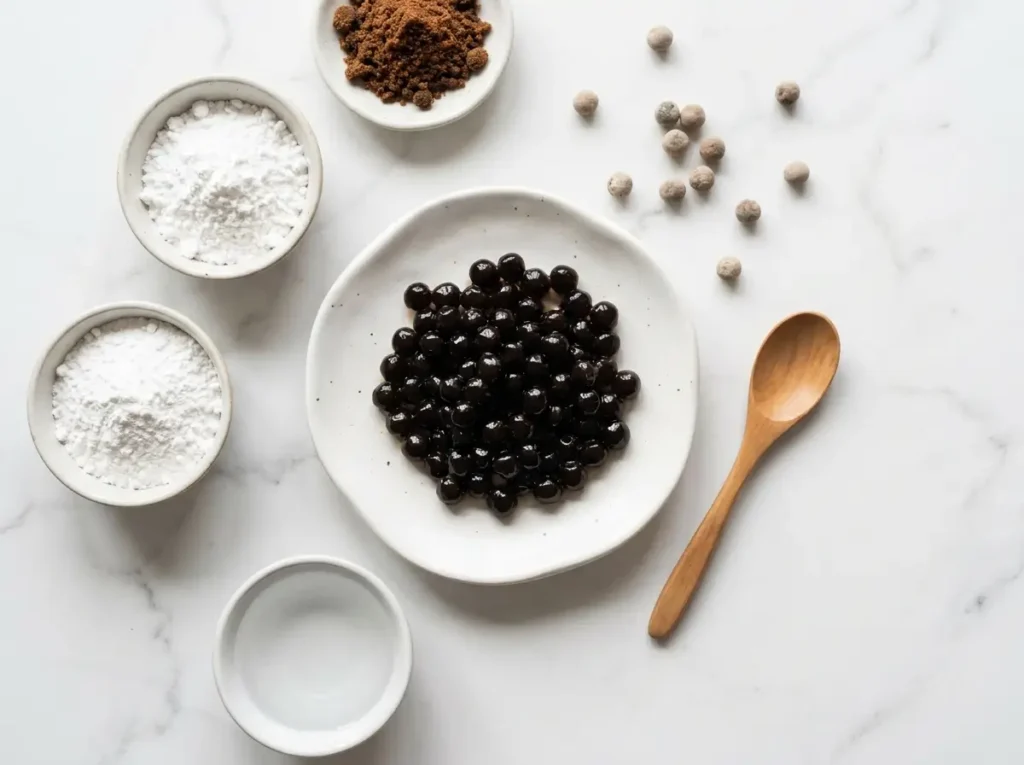
Homemade Boba Pearls — 3 Ingredients
- 1/2 cup tapioca starch, plus more for dusting
- 3 tablespoons brown sugar
- 3 tablespoons hot water (just off the boil)
- Dissolve brown sugar in hot water in a small saucepan over medium heat. Remove from heat.
- Immediately add 3 tablespoons of tapioca starch to the hot sugar water. Stir quickly — it will begin to thicken into a paste (the starter dough).
- Add remaining tapioca starch and mix until a soft, pliable dough forms. If too sticky, add tapioca starch one teaspoon at a time.
- Roll dough into small ropes and cut into small pieces. Roll each piece between your palms into a ball.
- Boil in water for 20-25 minutes until the pearls float and are chewy throughout. Drain and coat in brown sugar syrup.
Store cooked boba in brown sugar syrup at room temperature for up to 4 hours. Cooked boba hardens in the fridge — make fresh for best texture.
Frequently Asked Questions
Does boba have gelatin?
No. Traditional tapioca boba pearls are made from cassava starch, brown sugar, and water — no gelatin. The chewy texture comes from starch gelatinization, not from animal-derived gelatin.
Is boba vegan?
The boba pearls are vegan. Whether the full bubble tea drink is vegan depends on the milk base — ask for oat, soy, almond, or coconut milk instead of cow’s milk or non-dairy creamer.
Is boba halal?
Yes. Standard tapioca boba contains no animal-derived ingredients and is halal-friendly. Confirm the milk base with the shop.
What is boba made of?
Tapioca starch (from cassava root), brown sugar, and water. Those three ingredients are all that is needed for standard black boba pearls.
Does popping boba have gelatin?
No. Popping boba is made through spherification using sodium alginate (from seaweed) and calcium lactate. No gelatin is involved. It is fully vegan.
Does boba tea have dairy?
Traditional bubble tea uses cow’s milk or non-dairy creamer. Most boba shops offer plant-based milk alternatives. The boba pearls themselves contain no dairy.
Does Boba Have Gelatin? No — Here Is Exactly What Tapioca Pearls Are Made Of
- Total Time: 40 minutes
- Yield: 4 portions 1x
Description
Un délicieux cabillaud gratiné, nappé d’une onctueuse crème au chorizo, parfumé aux herbes fraîches.
Ingredients
- 4 filets de cabillaud frais
- 200g de chorizo
- 300ml de crème fraîche épaisse
- 2 échalotes
- 3 gousses d’ail
- 1 bouquet de ciboulette
- Sel et poivre du moulin
- 2 cuillères à soupe d’huile d’olive
Instructions
- Préchauffer le four à 180°C.
- Émincer finement les échalotes et l’ail.
- Couper le chorizo en petits dés.
- Dans une poêle, faire revenir les échalotes et l’ail dans l’huile d’olive.
- Ajouter le chorizo et faire revenir 2-3 minutes.
- Verser la crème fraîche, saler légèrement et poivrer.
- Laisser mijoter 5 minutes à feu doux.
- Disposer les filets de cabillaud dans un plat allant au four.
- Napper de la crème au chorizo.
- Enfourner pour 15-20 minutes.
- Parsemer de ciboulette ciselée avant de servir.
Notes
Choisir un cabillaud bien frais. La cuisson doit être surveillée pour garder le poisson moelleux.
- Prep Time: 15 minutes
- Cook Time: 25 minutes
- Category: Plat Principal
- Method: Au Four
- Cuisine: Française
Nutrition
- Serving Size: 1 portion
- Calories: 450
- Sugar: 3g
- Sodium: 600mg
- Fat: 28g
- Saturated Fat: 12g
- Unsaturated Fat: 14g
- Trans Fat: 0g
- Carbohydrates: 8g
- Fiber: 1g
- Protein: 42g
- Cholesterol: 120mg
Keywords: cabillaud, chorizo, poisson, crème, four, plat principal