

The Barefoot Contessa grape nut pudding recipe is one of those quietly iconic desserts that’s been making a slow but steady comeback — and for good reason.
If you’ve been searching for the Barefoot Contessa grape-nut pudding recipe, you’re not alone. This quietly iconic dessert has been making a slow but steady comeback — and for good reason. It’s the kind of recipe that doesn’t look like much on paper, yet delivers something deeply satisfying: a silky, custardy pudding with just enough texture from the Grape-Nuts cereal to keep every bite interesting.
Inspired by Ina Garten’s love for unfussy, timeless recipes, this version stays true to the spirit of the Barefoot Contessa — simple, high-quality ingredients, no shortcuts on technique, and results that genuinely impress. Whether you’re discovering Grape-Nut pudding for the first time or revisiting a childhood memory, this guide walks you through everything: the history, the ingredients, the method, tips, variations, and common mistakes to avoid.
What Is Grape-Nut Pudding? A Short History Worth Knowing
Grape Nut pudding is a traditional New England baked custard made with Grape-Nuts cereal, eggs, milk, cream, and sugar. It dates back at least to the early 20th century and is particularly associated with Rhode Island and Massachusetts home cooking. In some households, it was a Sunday dessert staple — humble, nourishing, and deeply comforting.
What makes it unusual is the role of the cereal. Unlike crumbled cookies or cake layers in other pudding recipes, Grape-Nuts don’t add crunch — they soften during baking and absorb the custard around them, contributing a subtle, slightly nutty texture and a mild wheaty flavor that pairs beautifully with vanilla and warm spice.
The name “Grape-Nuts” is famously misleading: the cereal contains neither grapes nor nuts. It’s made from whole wheat flour and barley, giving it a dense, earthy character that works surprisingly well in a baked dessert context.
Versions of this recipe can be found across New England cookbooks and on the back of old Post Grape-Nuts cereal boxes. The Barefoot Contessa-style approach simply refines what was already a classic — using full-fat dairy, fresh eggs, real vanilla, and just enough restraint on the sugar to let the flavors breathe.
Why the Barefoot Contessa Approach Makes This Recipe Work
Ina Garten has made a career out of taking classic American and French recipes and applying one clear principle: use better ingredients and don’t overthink it. Her version of grape-nut pudding follows that same logic.
A few things set this approach apart from generic recipes:
- Whole milk and heavy cream — this combination gives the custard its luxuriously smooth texture without making it too rich or eggy
- A water bath (bain-marie) — baking the pudding in a pan of hot water ensures even, gentle heat, which is the key to a smooth set without rubbery edges
- Vanilla extract, nutmeg, and salt — these small additions create a more complex, rounded flavor profile
- Soaking the Grape-Nuts in advance — a step that many recipes skip but that makes a noticeable difference in the final texture
This isn’t a complicated dessert. But done with this level of care, it goes from “old-fashioned” to genuinely memorable.
Key Ingredients — and Why Each One Matters
Every ingredient in this recipe plays a specific role. Understanding why each one is there will help you make better decisions if you need to substitute or adjust.
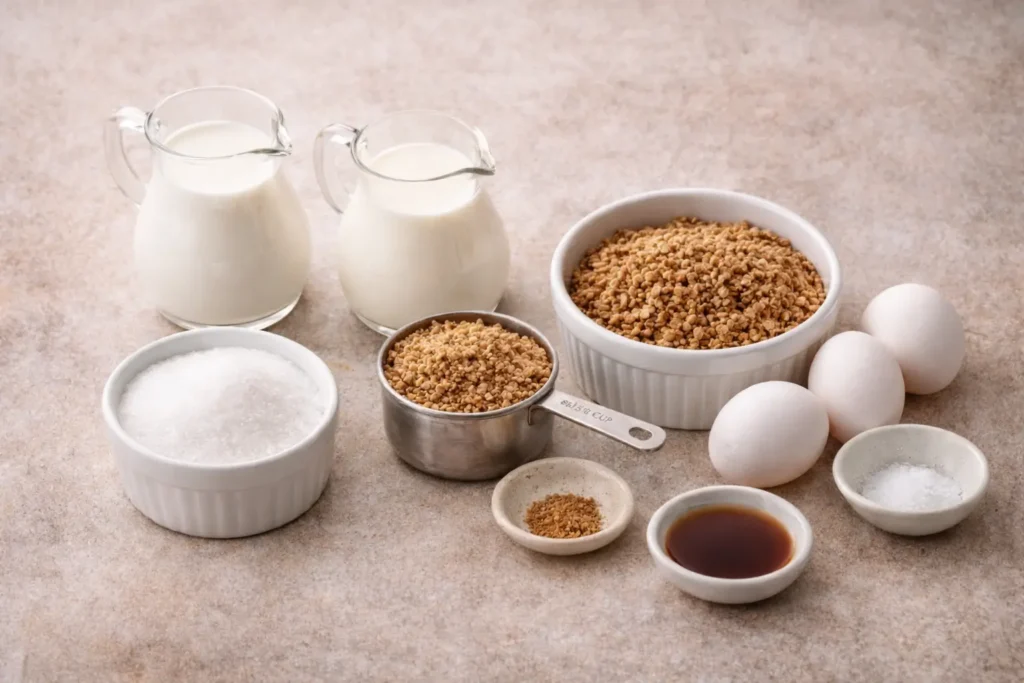
The table below gives you a quick overview before the detailed breakdown:
| Ingredient | Amount | Purpose |
|---|---|---|
| Grape-Nuts cereal | ¾ cup | Texture, subtle nuttiness, body |
| Whole milk | 2 cups | Base of the custard, silky consistency |
| Heavy cream | 1 cup | Richness and smoothness |
| Large eggs | 4 | Structure, set, and creaminess |
| Granulated sugar | ¾ cup | Sweetness and balance |
| Vanilla extract | 1½ tsp | Warmth and depth of flavor |
| Salt | ¼ tsp | Balances sweetness, enhances flavor |
| Ground nutmeg | ¼ tsp | Classic spice note |
Each of these ingredients contributes something essential to the final pudding. The fat from the cream and yolks is what gives it that silky mouthfeel — according to culinary sources, custards made with a higher fat content tend to set more smoothly and resist curdling better during baking. The salt, though small in quantity, is not optional: it rounds out the sweetness and prevents the dessert from tasting flat.
If you’re looking for a no-bake grape-nut pudding option, see the variations section below — though the baked version is generally considered superior in texture by most home bakers who’ve tried both.
Step-by-Step: How to Make Barefoot Contessa Grape-Nut Pudding
This recipe takes about 15 minutes of active prep time, plus approximately 50 minutes of baking and a cooling period before serving.

The table below gives you the full method at a glance before the detailed steps:
| Step | Action | Time |
|---|---|---|
| 1 | Soak Grape-Nuts in warm milk | 20 min |
| 2 | Whisk eggs, sugar, salt, vanilla | 3 min |
| 3 | Combine with cream and soaked cereal | 2 min |
| 4 | Pour into buttered baking dish | 2 min |
| 5 | Bake in water bath at 325°F | 45–55 min |
| 6 | Cool and serve | 30 min+ |
Step 1 — Soak the Grape-Nuts
In a medium bowl or measuring cup, combine the Grape-Nuts cereal with the whole milk. Let them soak for at least 20 minutes. This step is often skipped in rushed recipes, but it matters: it softens the cereal and allows it to absorb the milk, which ultimately creates a more cohesive, tender texture in the finished pudding.
Step 2 — Preheat and Prep
Preheat your oven to 325°F (165°C). Lightly butter a 2-quart baking dish or individual ramekins (either works — ramekins give more elegant individual portions; a larger dish is more casual and easier to serve family-style).
Place your buttered baking dish inside a larger roasting pan — you’ll be adding hot water later to create the water bath.
Step 3 — Make the Custard Base
In a large bowl, whisk together the eggs and sugar until pale and well combined, about 2 minutes. Add the salt, vanilla extract, and nutmeg. Whisk again.
Pour in the heavy cream and stir to combine. Then add the Grape-Nuts and milk mixture — cereal, milk, and all. Stir gently to incorporate everything without creating excessive foam.
Step 4 — Fill the Dish and Add the Water Bath
Pour the custard mixture into your prepared baking dish. Carefully slide the roasting pan into the preheated oven, then pour hot water (not boiling — hot from the tap or just simmered) into the roasting pan until it reaches halfway up the sides of the baking dish.
This is the water bath. It insulates the custard from direct oven heat, which is what allows it to bake evenly and gently.
Step 5 — Bake
Bake at 325°F for 45 to 55 minutes, or until the custard is set around the edges but has a very slight wobble in the center when you gently shake the pan. It will continue to firm up as it cools — pulling it out when it looks fully firm often results in overbaking.
A toothpick inserted about an inch from the edge should come out clean. The center may still look a little glossy; that’s fine.
Step 6 — Cool Before Serving
Carefully remove the baking dish from the water bath (use oven mitts — the water will be very hot). Let the pudding cool on a wire rack for at least 30 minutes before serving warm, or refrigerate for 2–3 hours and serve cold.
Tips for a Perfectly Silky, Creamy Texture
Getting the texture right in a baked custard takes attention to a few details that don’t always make it into basic recipes:
- Don’t skip the water bath. It’s the single most important technique for a smooth, crack-free custard. Without it, the edges tend to overbake and turn rubbery while the center is still runny.
- Use room-temperature eggs. Cold eggs can cause the custard to curdle slightly when combined with warm milk. Letting eggs sit at room temperature for 20–30 minutes before using is generally recommended.
- Strain the mixture if needed. If you see any stringy bits of egg white after whisking, straining the custard through a fine-mesh sieve before pouring it into the dish can give you a cleaner, silkier result.
- Don’t overbake. A slight jiggle in the center when you pull the dish from the oven is correct. The residual heat will finish the job.
- Low and slow is the rule. 325°F is the target. Higher temperatures are more likely to produce a grainy or weeping custard.
Variations Worth Trying
Once you’re comfortable with the base recipe, there are several directions you can take it:
Maple Grape-Nut Pudding — Replace ¼ cup of the granulated sugar with pure maple syrup. This adds a warm, autumnal depth that works especially well in the fall and winter months.
Grapenut Custard — Microwave Version — For a quicker option, some home cooks have reported reasonable results making individual portions in the microwave using a lower power setting. The texture is generally softer and less cohesive than the baked version, but it can work in a pinch. Cook at 50% power in 2-minute increments, checking for doneness after each interval.
No-Bake Grape-Nut Pudding — While not technically a custard, a no-bake version can be made by combining softened Grape-Nuts with whipped cream, cream cheese, and sugar to create a chilled dessert that’s closer in texture to a mousse. It’s a lighter, quicker option, though it lacks the depth of flavor that baking develops.
King Arthur–Style Baked Version — King Arthur Baking also has a grape-nut pudding recipe in their archives that leans toward a slightly denser, breadier texture. Comparing the two is a fun experiment for baking enthusiasts.
Serving Ideas

Grape-Nut pudding is quietly versatile when it comes to serving:
- Serve warm with a light dusting of cinnamon or an extra pinch of nutmeg on top
- Serve cold straight from the refrigerator — many people prefer the firmer, denser texture
- Add a small drizzle of maple syrup or honey on top just before serving
- Pair with a dollop of lightly whipped cream (unsweetened or barely sweetened works best)
- Serve alongside other classic comfort desserts — if you love Barefoot Contessa-inspired baking, the Barefoot Contessa Chicken Divan makes a wonderful savory counterpart for a full dinner party menu, and her Crab Quiche is another crowd-pleasing option from the same school of unfussy elegance
For a full dessert spread, this pudding pairs naturally with something fruit-forward — something like a Joanna Gaines Apple Crisp on the side creates a beautiful contrast of textures and flavors.
Storage, Freezing, and Reheating
| Method | Duration | Notes |
|---|---|---|
| Refrigerator | Up to 4 days | Cover tightly with plastic wrap or lid |
| Freezer | Up to 2 months | Texture may soften slightly after thawing |
| Reheating (oven) | 15–20 min at 300°F | Cover with foil to avoid drying out |
| Reheating (microwave) | 30–60 sec at 50% power | Check frequently; overheating ruins texture |
Grape-Nut pudding stores well in the refrigerator and, in some cases, tastes even better the next day once the custard has fully set and the flavors have had time to meld. Freezing is possible but may affect the silky texture slightly — it’s generally worth eating fresh or within a few days of baking.
Common Mistakes to Avoid
Even an easy recipe has its pitfalls. Here are the ones that come up most often with baked custards:
Skipping the soak — Grape-Nuts that go into the custard dry can create pockets of unabsorbed cereal that never fully soften. Always soak for at least 20 minutes.
Baking without a water bath — The result is almost always a curdled, weeping, or cracked custard. There’s no reliable workaround. Use the water bath.
Overbaking — Once the custard looks fully set through the oven window, it may already be too far along. Pull it when the center still has a gentle jiggle.
Using low-fat dairy — Skim milk or light cream can work in a pinch, but according to several baking sources, full-fat dairy produces a noticeably superior texture in baked custards. It’s worth using the real thing here.
Not letting it cool — Cutting into or serving a hot baked custard immediately can cause it to collapse or appear runny. A rest period of at least 30 minutes — longer if serving cold — is necessary.
Frequently Asked Questions
What is Grape-Nut pudding made of?
Grape-Nut pudding is a baked custard made from eggs, milk, heavy cream, sugar, vanilla, and Grape-Nuts cereal. The cereal softens during baking and absorbs the custard, giving the pudding a gentle, slightly chewy texture that's very different from smooth stovetop custards.
Is there a difference between Grape-Nut pudding and Grape-Nut custard?
The two terms are often used interchangeably. Technically, "custard" refers to the egg-and-dairy mixture itself — what this recipe produces is a baked custard pudding. Some recipes lean denser and more custardy; others are lighter. The distinction is mostly semantic.
Can you make Grape-Nut pudding without baking?
A no-bake version exists that uses whipped cream and cream cheese in place of baked eggs. The texture is softer and lighter, similar to a mousse or chilled dessert. It's a quicker option, though the depth of flavor that comes from baking is generally absent.
Why is New England so associated with Grape-Nut pudding?
Grape-Nut pudding has deep roots in New England home cooking, where it was a common farmhouse dessert in the early 20th century. The Post Grape-Nuts cereal was widely available and inexpensive, and the recipe appeared on cereal boxes and in community cookbooks for decades. It remains particularly popular in Rhode Island and Massachusetts.
How long does Grape-Nut pudding last in the fridge?
Covered tightly, baked Grape-Nut pudding can last up to 4 days in the refrigerator. As with most egg-based desserts, it's best consumed within the first 2–3 days for optimal texture and flavor.
Can you freeze Grape-Nut pudding?
It can be frozen for up to 2 months, though the custard texture may become slightly softer or grainier after thawing. If you do freeze it, thaw overnight in the refrigerator and allow it to come to room temperature before reheating or serving.

Barefoot Contessa Grape Nut Pudding
- Total Time: 1 hour 5 minutes
- Yield: 6 servings 1x
- Diet: Vegetarian
Description
A silky, custardy baked pudding with softened Grape-Nuts cereal, warm vanilla, and a hint of nutmeg — simple, nostalgic, and deeply satisfying.
Ingredients
- ¾ cup Grape-Nuts cereal
- 2 cups whole milk
- 1 cup heavy cream
- 4 large eggs
- ¾ cup granulated sugar
- 1½ tsp vanilla extract
- ¼ tsp salt
- ¼ tsp ground nutmeg
Instructions
- Combine Grape-Nuts and milk in a bowl and let soak for 20 minutes.
- Preheat oven to 325°F (165°C) and butter a baking dish.
- Whisk eggs and sugar until pale and smooth.
- Add salt, vanilla, and nutmeg, then whisk again.
- Stir in heavy cream.
- Add soaked Grape-Nuts mixture and mix gently.
- Pour into prepared baking dish.
- Place dish in a roasting pan and add hot water halfway up the sides.
- Bake for 45–55 minutes until edges are set and center slightly jiggles.
- Remove from water bath and cool at least 30 minutes before serving.
Notes
Do not skip soaking the cereal or the water bath. Bake gently and avoid overcooking to keep the custard smooth and creamy.
- Prep Time: 15 minutes
- Cook Time: 50 minutes
- Category: Dessert
- Method: Baked
- Cuisine: American
Nutrition
- Serving Size: 1 serving
- Calories: 320
- Sugar: 28g
- Sodium: 180mg
- Fat: 14g
- Saturated Fat: 8g
- Unsaturated Fat: 5g
- Trans Fat: 0g
- Carbohydrates: 38g
- Fiber: 2g
- Protein: 8g
- Cholesterol: 140mg
Keywords: grape-nut pudding, barefoot contessa, custard dessert, baked pudding, classic dessert