
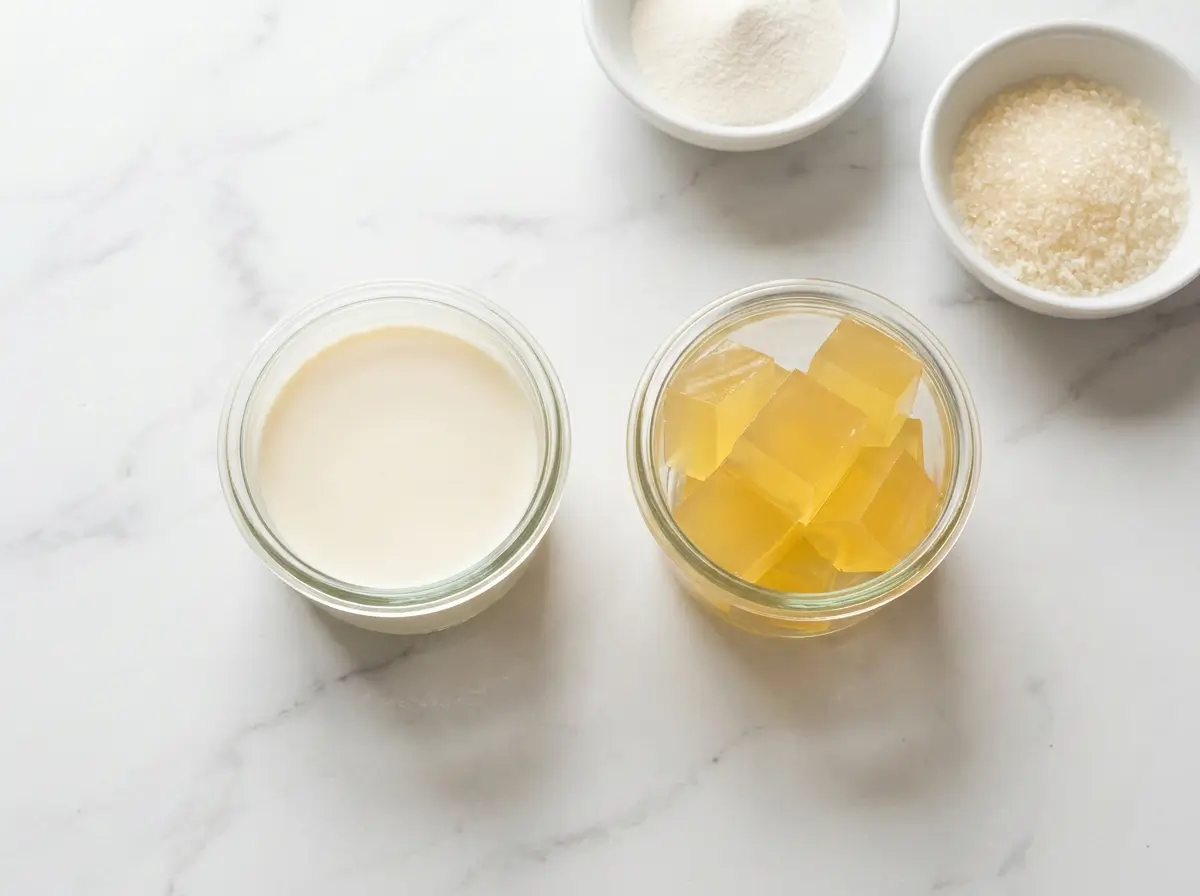
Agar agar vs gelatin — these two ingredients look almost identical in the bag, and they both make things firm and jiggly. But they are not the same, and swapping one for the other without knowing the rules will leave you with a dessert that refuses to set or turns into a rubbery brick.
If you’ve ever hit that question mid-recipe, you’re in the right place. This guide covers exactly what each one is, how they work, which one belongs in your kitchen — with a comparison table and a recipe to try.
What Is Gelatin?
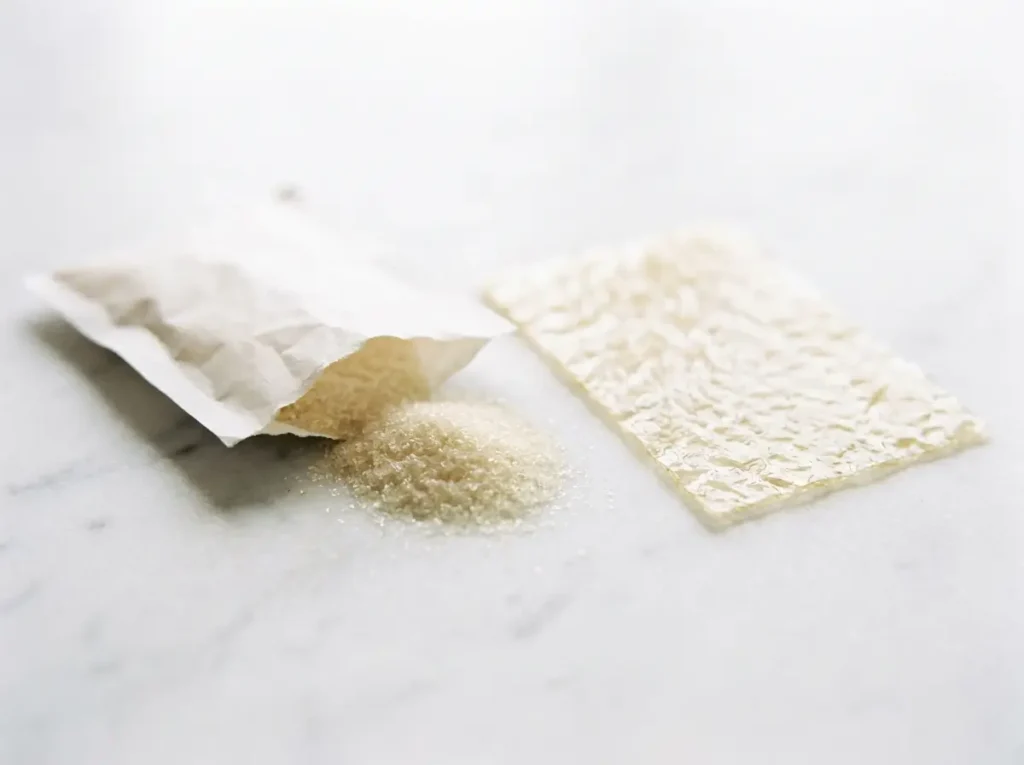
Gelatin is a protein derived from the collagen found in animal bones and connective tissue — typically from beef (bovine) or pork. It comes as a fine powder or as thin translucent sheets, and it dissolves in warm liquid then sets firm as it cools.
It has been used in kitchens for centuries, from classic aspic to Jell-O, panna cotta, marshmallows, and gummy candies.
Key facts about gelatin:
- Animal-derived — not vegan, not always halal
- Sets firm but stays silky and soft in the mouth — that “melt on your tongue” quality
- Melts again at body temperature (around 98°F / 37°C)
- Must be bloomed in cold water before use (see how to bloom gelatin for the full technique)
- Cannot be re-set once melted and mixed with acidic ingredients like fresh pineapple or papaya
- Available as Knox powder or sheet gelatin in most US grocery stores
Halal note: Pork gelatin is haram. If you are cooking for a halal household, always look for beef gelatin certified halal, or use agar agar. For a full breakdown, see Is Beef Gelatin Halal?
What is Gelatin? — Encyclopedia Britannica DA ~95 — source encyclopédique, signal E-E-A-T fort pour Bing
What Is Agar Agar?
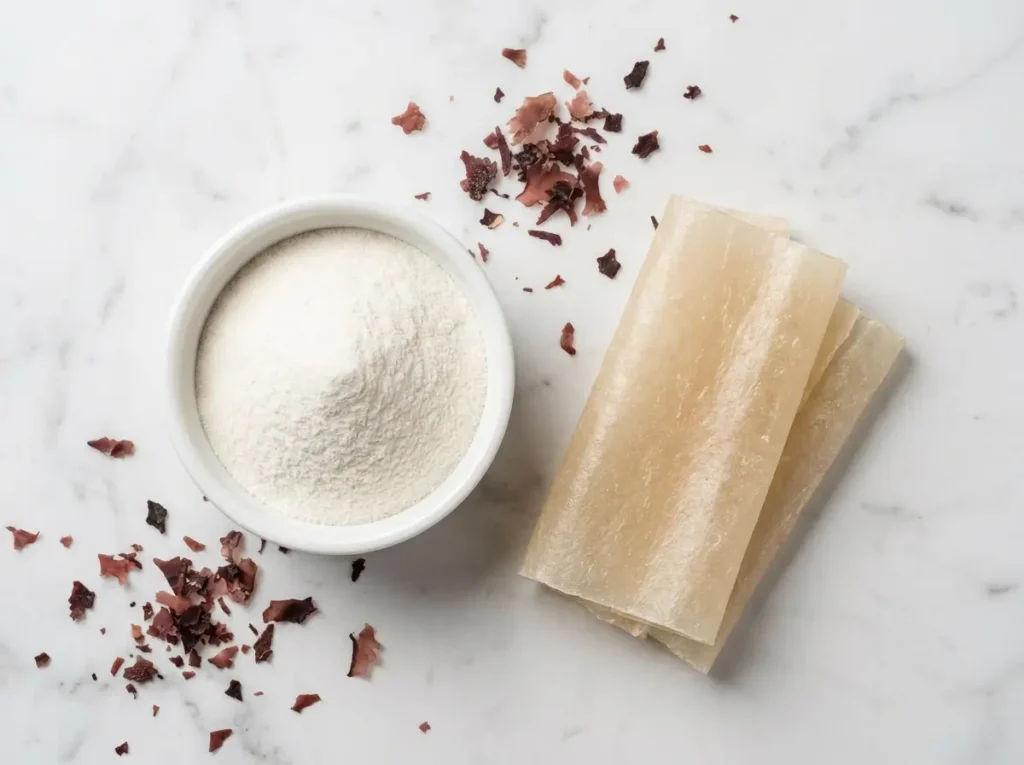
Agar agar (often just called agar) is a plant-based gelling agent made from red algae. It has been used in Asian kitchens — particularly Japanese and Chinese — for hundreds of years before it ever became a Western “vegan alternative.”
It comes as a powder, flakes, or bars, with powder being the easiest to measure and use in recipes. You’ll find it in Asian grocery stores, health food stores, and online.
Key facts about agar agar:
- 100% plant-based — vegan, vegetarian, and naturally halal
- Sets firmer and more solid than gelatin — think a firm jello vs. a silky panna cotta
- Does not melt at body temperature — stays solid even at room temperature
- Must be boiled (not just dissolved) to activate — a crucial difference
- Holds up better in warm climates or on dessert tables where things sit out
- Works with acidic fruits like pineapple and kiwi — where gelatin fails
- Flavor is very neutral when used correctly
Agar — PubChem / National Library of Medicine DA ~95 — source scientifique gouvernementale US, crédibilité maximale
Agar Agar vs Gelatin: Side-by-Side Comparison
| Gelatin | Agar Agar | |
|---|---|---|
| Source | Animal (beef or pork) | Plant (red algae) |
| Vegan / Vegetarian | ❌ No | ✅ Yes |
| Halal | ⚠️ Only if beef-certified | ✅ Yes |
| Texture | Soft, silky, melts in mouth | Firm, bouncy, holds shape |
| Sets at room temp | ❌ Needs refrigeration | ✅ Yes |
| Melts when warm | ✅ Yes (body temp) | ❌ Stays firm |
| Works with acidic fruit | ❌ Breaks down (raw pineapple, kiwi) | ✅ Yes |
| Activation method | Bloom in cold water, dissolve in warm liquid | Must boil to activate |
| Substitution ratio | — | Use ½ tsp agar powder per 1 tsp gelatin |
| Best for | Panna cotta, mousse, marshmallows, cheesecake | Jello, Asian desserts, dairy-free recipes |
| Flavor | Very neutral | Very neutral |
How to Substitute Agar Agar for Gelatin
This is where most recipes go wrong. Agar agar is stronger than gelatin, so you cannot use them 1:1.
General rule: use ½ teaspoon agar agar powder for every 1 teaspoon of gelatin powder called for in a recipe.
A few extra tips:
- Always dissolve agar agar in liquid first, then bring it to a full boil for at least 2 minutes. Simmering is not enough.
- Let the mixture cool slightly before pouring into molds — it sets fast.
- If your agar dessert comes out too firm, use less next time. If it doesn’t set, you didn’t boil it long enough.
- Agar flakes are weaker than powder — 1 tablespoon of flakes equals roughly 1 teaspoon of powder.
When to Use Gelatin
Gelatin is the right choice when:
- You want that classic, cloud-soft, melt-in-your-mouth texture — panna cotta, mousse, no-bake cheesecakes
- The recipe specifically requires gelatin (like traditional marshmallows or aspic)
- You are cooking for non-vegan households and using certified halal beef gelatin
- The dessert will stay refrigerated and cold the entire time before serving
Agar Agar: Nutrition and Uses — Healthline DA ~90 — source santé mainstream, naturellement citée sur ce type de comparatif
When to Use Agar Agar
Agar agar is the right choice when:
- You are cooking for a vegan, vegetarian, or strictly halal household
- You need a dessert to hold up at room temperature — a dessert buffet, a warm kitchen, outdoor serving
- The recipe includes fresh acidic fruits like pineapple, kiwi, or mango
- You are making layered jello or sliceable desserts that need clean cuts
- You want to make a gelatin-free jello recipe that everyone can eat
What About Pectin?
Pectin is another plant-based thickener — but it works very differently. It is mainly used in jams and jellies, not in desserts. For a full breakdown of how pectin compares, see the dedicated pectin vs gelatin guide. For a broader look at all your options, the plant-based gelatin substitutes article covers agar, pectin, cornstarch, arrowroot, and more.
Pectin — USDA FoodData Central DA ~90 — source USDA officielle, renforce l’autorité thématique food sur Bing
Simple Agar Agar Jello (3 Ingredients)
This recipe works with any fruit juice. It sets firm, holds at room temperature, and takes 5 minutes to make.
Ingredients (serves 4):
- 2 cups fruit juice of your choice (mango, strawberry, or grape work beautifully)
- 1 teaspoon agar agar powder
- 1 tablespoon sugar (optional, adjust to taste)
Instructions:
- Pour the juice into a small saucepan. Sprinkle the agar agar powder over the surface and whisk to combine.
- Bring to a full boil over medium heat, stirring constantly. Boil for 2 full minutes — this step is not optional.
- Remove from heat. Stir in sugar if using.
- Pour immediately into molds, glasses, or a baking dish.
- Let cool at room temperature for 20 minutes, then refrigerate for 1 hour until fully set.
- Unmold and serve, or slice into cubes directly from the dish.
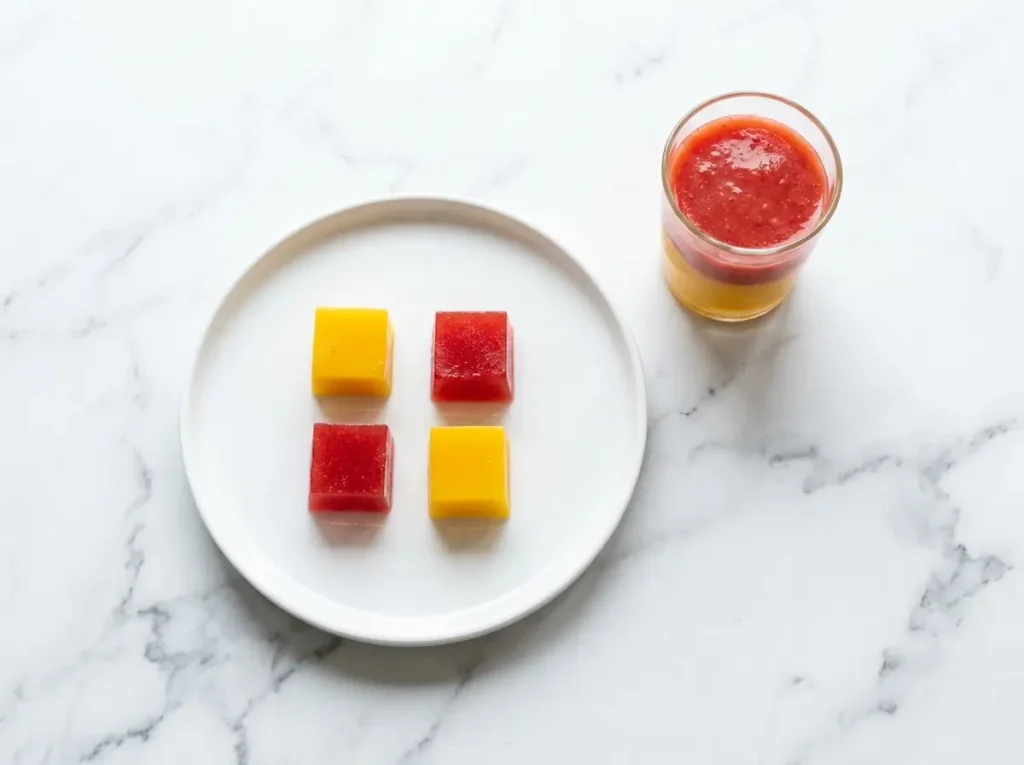
Sophie’s tip: For a layered version, pour half the mixture, let it set for 20 minutes, then pour the second layer (a different juice) on top. The layers hold perfectly because agar sets firm — something gelatin can’t always pull off cleanly.
For more jello-style ideas that are fully gelatin-free, try these jello and marshmallow recipes or make a classic jello candy recipe using agar instead.
Frequently Asked Questions
Can I use agar agar in panna cotta instead of gelatin?
Yes, but the texture will be different — firmer and less silky. If you want a traditional panna cotta with that cloud-like wobble, gelatin gives better results. For a dairy-free, firmer version, agar works well. See the easy panna cotta recipe for the classic base.
Does agar agar taste like anything?
No. When used in the correct amount, agar is completely tasteless. If you taste something seaweed-like, you used too much.
Is agar agar the same as gelatin?
No. Gelatin is animal-derived and protein-based. Agar is plant-derived and carbohydrate-based. They both gel liquids but through completely different mechanisms, and the textures they produce are distinct.
Does agar agar work in mousse or whipped desserts?
Not well. Agar sets firm and does not have the elastic quality gelatin has. For mousse, whipped cheesecake, or anything that needs to stay light and airy, gelatin (or a recipe specifically developed for agar) is the better choice.
Which is healthier — agar agar or gelatin?
Both are very low in calories. Gelatin contains collagen protein. Agar contains fiber and no protein. Neither is a significant nutritional source when used in small quantities in desserts — the difference comes down to dietary requirements, not health claims.
Can I use both in the same recipe?
It’s not recommended. They set differently and can produce an inconsistent texture. Stick to one or the other per recipe.
Sophie is the food blogger behind SISTAFOOD — a comfort food and everyday recipe site for the home cook. All recipes are pork-free and alcohol-free.
1 thought on “Agar Agar vs Gelatin — What’s the Difference and Which Should You Use?”